Why foundations move in Murfreesboro
Texas has deep clay and Florida has sand. Murfreesboro has something of its own: hard, level limestone with a thin and uneven cover of clay, and water that leaves by going down.
Bedrock
Limestone that is never far away
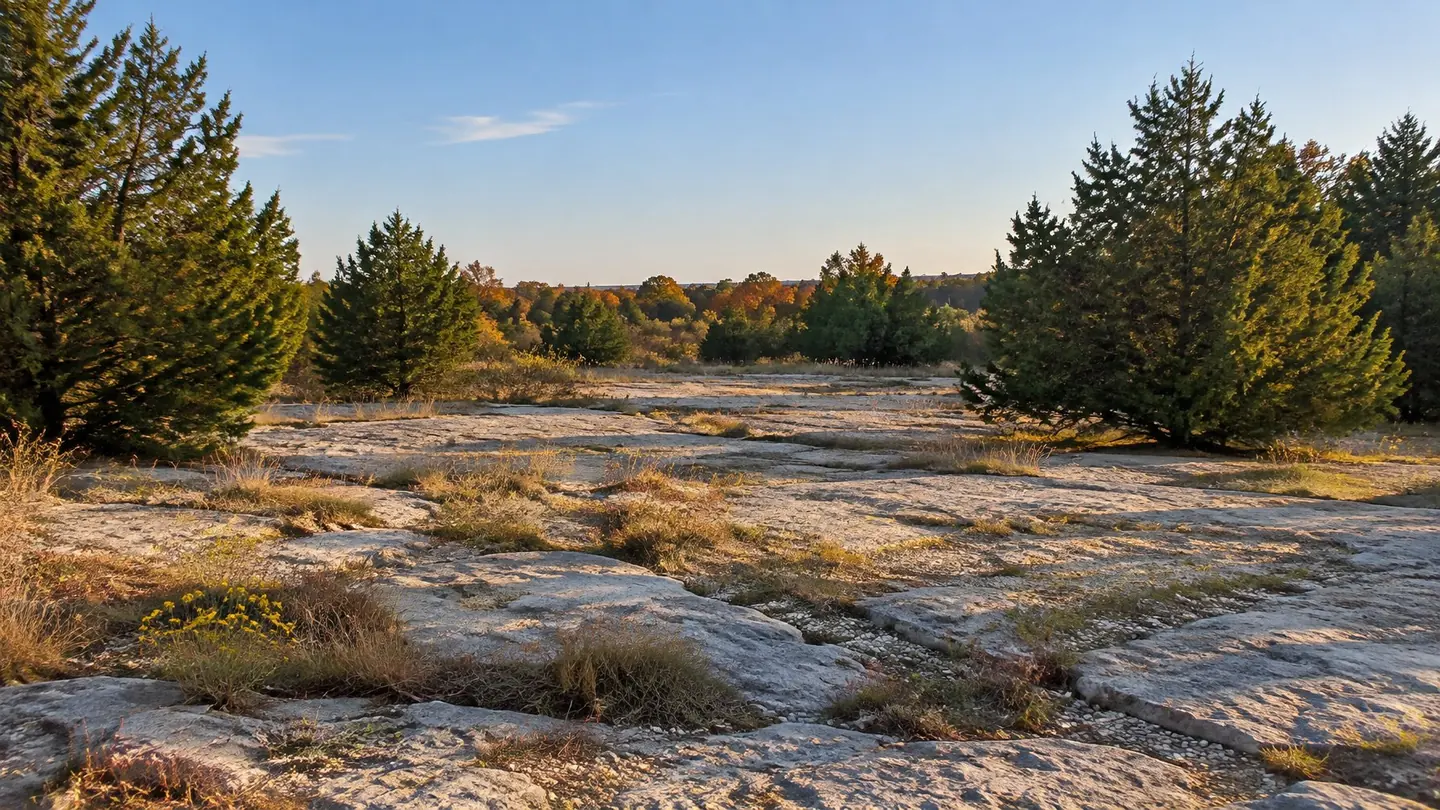
The U.S. Geological Survey, working with the City of Murfreesboro, describes the area as thin soils on flat-lying limestone, with beds of rock exposed at the surface in many places. In some spots, it says, the soil is very thin or missing altogether and collects mainly in the vertical cracks of the rock.
You can see it for yourself. The cedar glades around town, and the outcrops in the fields at Stones River National Battlefield, are that bedrock with almost nothing on top. In a subdivision the same rock is may be hidden by soil or placed fill. A nearby outcrop does not establish the depth beneath a house.
Federal soil descriptions for this basin put numbers on it. One common upland soil has limestone three to twelve inches down. Another has it at twenty to forty inches, and a third at forty to sixty. Depth to rock is that changeable.
What that does to a house
Part of the footing on rock, part on clay
Clay can change volume as moisture changes. A footing crossing a place where the rock dips away may bear on rock at one end and soil at the other. An inspection establishes how the house is supported.
Dry weather or leaking gutters can change moisture in the soil. If the supports move differently, the house can develop uneven movement. Brick or drywall cracks may be one clue, but their cause needs checking at the property.
It also explains why neighbours with identical floor plans can have very different experiences. The difference is under the lawn.
Soil and water
Two more things working on the foundation
Clay subsoil
The same soil descriptions call the subsoil silty clay or clay, formed as the limestone weathered. Clay takes up water slowly and gives it up slowly. It swells through a wet winter and pulls back in late summer, when cracks open in bare ground. Large trees close to a house draw extra water out of it in dry spells.
Karst drainage
Every limestone layer under the area has some solution openings, according to the survey, along with sinkholes, springs, caves and streams that vanish underground. Water moving down into those openings can take soil with it. That is how a depression forms in a yard that was flat.
Weather
Wet winters, stormy springs, dry spells
Average rainfall here is a little over fifty inches a year. The survey records that the storms which flood streams and sinkholes are mostly big winter systems from December through March and intense thunderstorms from April through September.
Its study of flooded sinkholes around the city found that some drained within days and others stayed full much longer, and that sending more water toward a sinkhole raised or lengthened its flooding. For a homeowner the lesson is plain: know where your roof water and yard water end up, and do not pipe it to a low spot you do not understand.
Houses
Three kinds of foundation, three ways of showing it
Crawl space houses show ground movement as dips and bounce in the floors and as doors going out of square, because the piers under the main beam stand on the clay. Slab houses show it as cracks in the concrete and in tile laid on it. Basement houses show it in the walls.
Lots in newer subdivisions on rolling ground are often levelled by cutting into the high side and filling the low side. Filled soil can settle for some years, which is why the garage or porch at the built-up end of a house is sometimes the first place to crack.
Use this on the phone
Local details worth telling a foundation company
- Whether rock shows anywhere in your yard, or a fence or mailbox post hit rock when it was set.
- Which side of the lot was the low side before the house was built, if you know.
- Where water stands after a storm and how many days it stays.
- Any dip in the yard, new or old, and how close it is to the house.
- Large trees within a branch-spread of the foundation.
You can look up the soil mapped on your own lot in the federal Web Soil Survey. It will not tell you what is wrong with a house, but depth to bedrock is listed for each soil, and that bears on what piers cost.
One phone call
Speak with a foundation repair company near Murfreesboro
Mention the crack, the dip or the lean, name the room, and give the month you first spotted it. Whoever picks up belongs to a Middle Tennessee foundation outfit whose only tie to this website is the referral. They can pencil in an inspection and follow it with a written price.
A house that is cracking as you listen, a wall on the point of failing, gas in the air: everybody outside first, then 911 and the gas company.
Expect the call to be recorded. Two short pages cover the rest: who pays for referrals and what becomes of call details.