Bowing or leaning basement walls
A basement wall spends its whole life holding back the soil outside it. Concrete block, which many basement and crawl space walls are built from, is strong when squeezed from above and weak when pushed from the side.
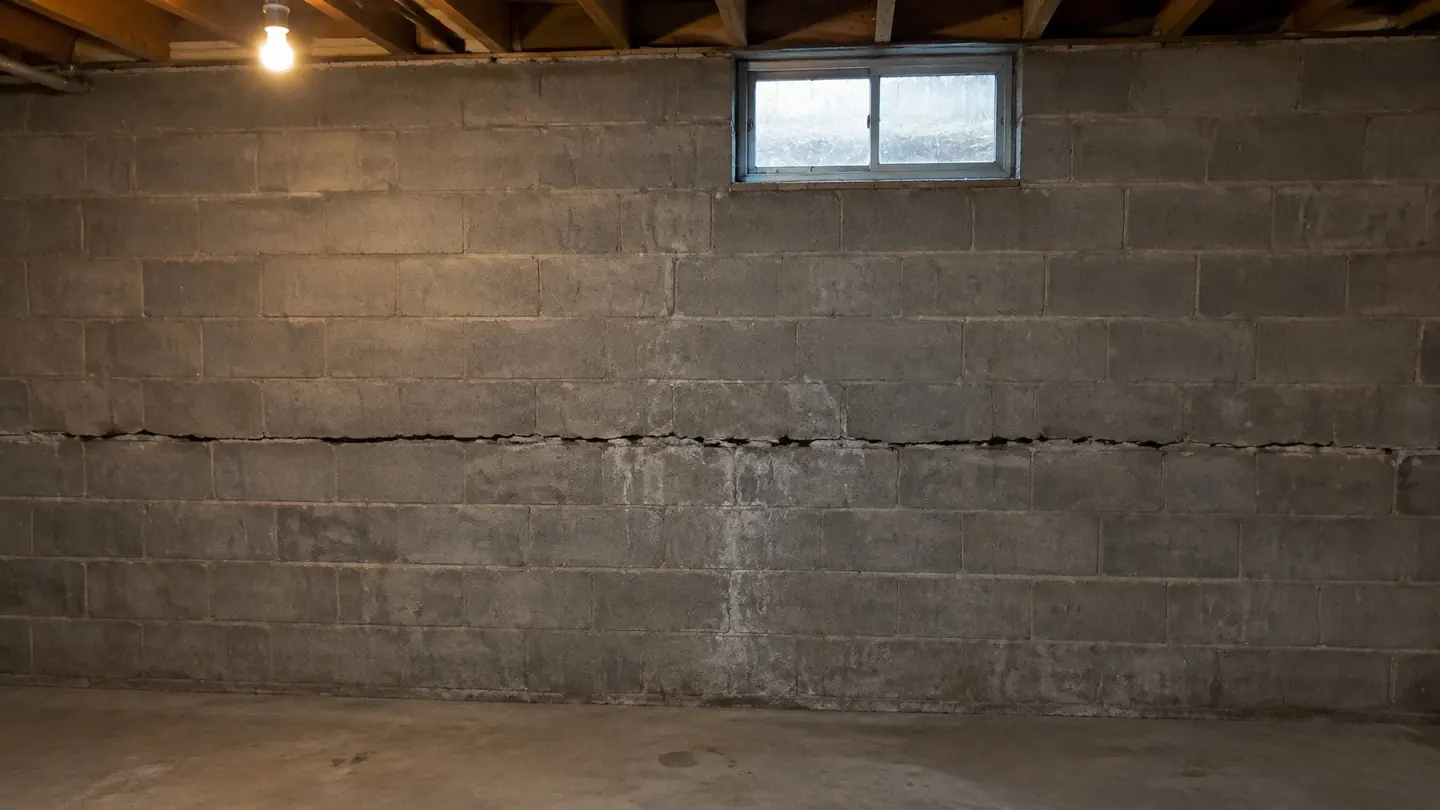
Recognising it
Signs that a wall is being pushed in
- A horizontal crack running most of the wall's length, usually between a third and halfway up.
- Stair-step cracks rising from the bottom corners toward that horizontal one.
- A belly you can see by holding a long straight board or a taut string against the wall.
- The top of the wall tipped inward, with a gap between the block and the wood sill that sits on it.
- The bottom course staying put while the wall above it has slid inward a little.
Short crawl space walls can lean the same way, and you will usually notice it from outside as a foundation wall that is no longer plumb under the siding or brick.
The cause
Where the sideways force comes from
Soil leans on a basement wall all the time. Clay leans harder when it is wet, because it swells and because water trapped in the backfill adds its own weight. A downspout that empties at the base of the wall, a flower bed that slopes toward the house or a long wet winter can each raise that load.
On a hillside lot the uphill wall holds back more ground than the others. A driveway or parked vehicle close to a wall adds to it. Large tree roots can as well.
Not every mark on a block wall is pressure. Thin step cracks with no bulge, old patches that have not reopened, and paint lifting from damp are common and may mean little. A wall has to be measured to know.
Repair approaches
Holding a wall, pulling it back, or rebuilding it
Bracing from inside
Steel beams set upright against the wall and fixed at floor and ceiling, or carbon fibre straps bonded to the block. Both are meant to stop a modest bow from growing. Neither needs digging outside.
Anchoring to the soil outside
Steel rods run through the wall to plates or screw-in anchors buried in the yard. Some systems can be tightened in later seasons to draw the wall back gradually.
Excavating and rebuilding
For a wall that has moved a long way: the soil is dug out, the wall is straightened or relaid, and drainage is put in before the trench is filled.
Ask about rock
Shallow limestone changes the options
Anchors need a certain distance of firm ground to grip, and digging beside a wall here can meet limestone within a few feet. Ask any company how its design copes if the crew hits rock sooner than expected, and whether an engineer has sized the braces or anchors for your wall.
If water seeps through the wall but nothing has cracked or bulged, that is a job for a waterproofing specialist and not for a foundation repair crew.
Until someone has seen it, do not dig along the outside of a bowed wall yourself and do not stack heavy storage against it.
Questions
About bowing walls
How far can a wall bow before it has to be fixed?
There is no single figure that applies to every wall, and this page will not give one. Height, block size, what the wall carries and whether the bow is growing all matter. An engineer or a repair company measures it and tells you.
Do poured concrete walls bow?
Less often. They more commonly crack vertically or tip as one piece. The repair choices overlap but are designed differently.
Will fixing the gutters straighten the wall?
No, but it removes part of the load and is normally done alongside any structural repair.
One phone call
Speak with a foundation repair company near Murfreesboro
Mention the crack, the dip or the lean, name the room, and give the month you first spotted it. Whoever picks up belongs to a Middle Tennessee foundation outfit whose only tie to this website is the referral. They can pencil in an inspection and follow it with a written price.
A house that is cracking as you listen, a wall on the point of failing, gas in the air: everybody outside first, then 911 and the gas company.
Expect the call to be recorded. Two short pages cover the rest: who pays for referrals and what becomes of call details.