Stair-step cracks in brick, and cracks in walls and ceilings
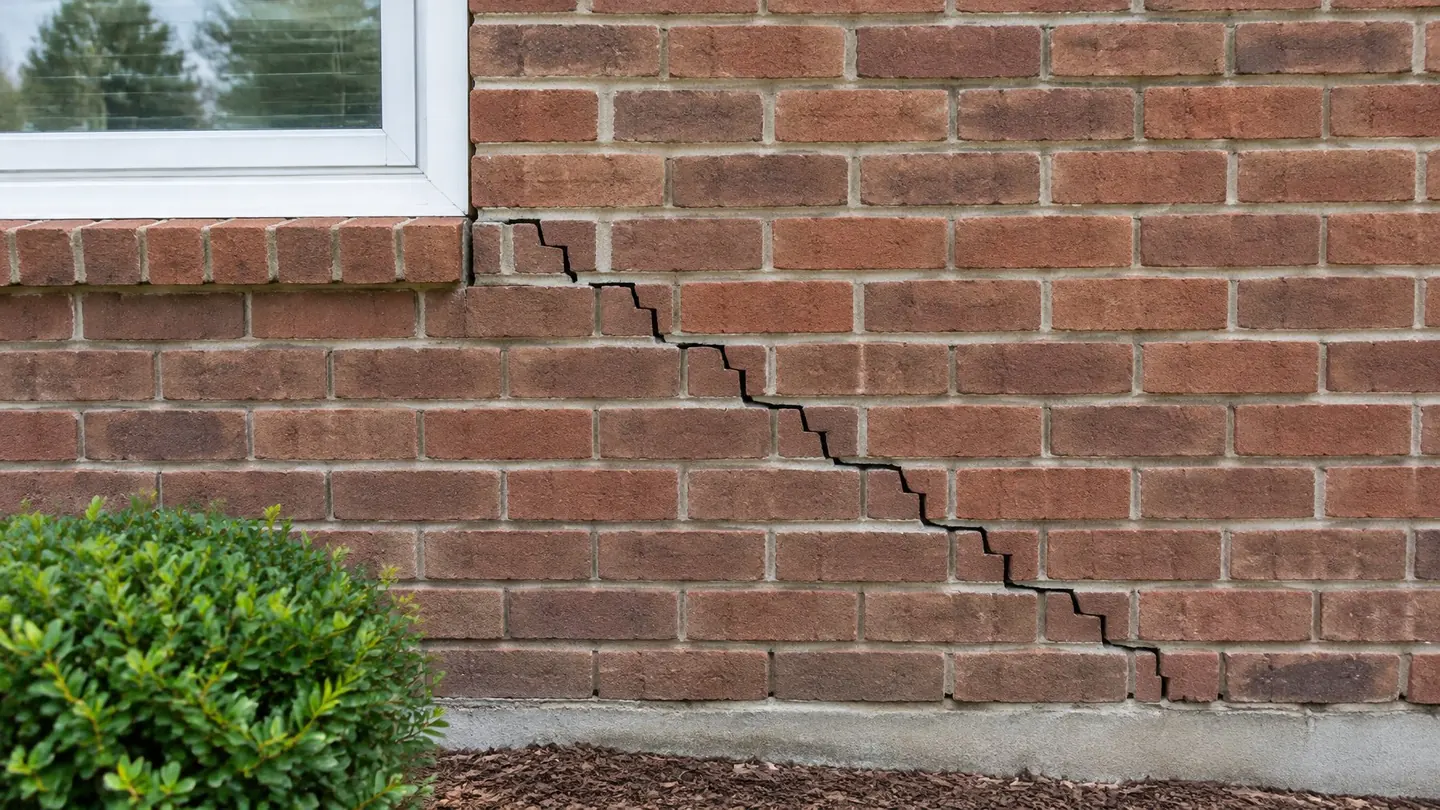
Brick fronts are everywhere in Murfreesboro, and brick is honest about movement. The crack people notice first climbs the mortar joints like a flight of stairs.
Outside and inside
How these cracks usually show up
Mortar is softer than the brick it holds, so when a wall is bent the crack zigzags through the joints. Stair-step cracks tend to begin where the wall is weakest: at the corner of a window or door opening, or near the end of a wall.
Indoors the same movement draws a diagonal crack up and away from the top corner of a door or window. It can also split a ceiling across the middle of a room, away from any drywall seam, and open the mitred joints of crown moulding and door casing.
- Is the crack wider at the top than at the bottom, or the other way round?
- Does one side of it stand out further than the other when you run a finger across?
- Has it come back through caulk, mortar patching or fresh paint?
- Is there a crack on the inside of that same wall, or a door nearby that has started to rub?
Those four answers are what a foundation company will ask for first.
Telling them apart
Foundation movement, or something more ordinary
Points toward the foundation
- A crack that is clearly wider at one end, which means the wall has rotated.
- Brick pulling away from a window or door frame and leaving a gap you can see into.
- A sticking door or a falling floor in the room behind the crack.
- A crack that reopens within a season of being repointed.
Often has another cause
- A rusting steel lintel over a window or garage door, which swells and lifts the brick above it.
- Thin vertical cracks in a long run of brick with no expansion joint, from heat and cold.
- Hairline cracks along drywall tape and popped nail heads in a house only a few years old, as framing lumber dries.
- A ceiling crack under roof trusses that opens in winter and closes again by summer.
Local ground
Why one end of a brick wall drops
Brick veneer rests on a ledge at the top of the foundation. It has almost no ability to bend, so it records any difference in how the footing below is supported.
In Murfreesboro that difference is often built into the lot. Limestone lies close to the surface and its depth changes over a short distance, so a footing can sit on rock at one end and on clay at the other. The clay moves with the seasons and the rock does not. The local ground guide explains the soil and rock in more detail.
At the inspection
What a foundation company checks
The foundation under the crack
Whoever inspects follows the crack down to the footing, the crawl space wall or the slab edge to see whether the concrete or block has cracked too.
Floor heights across the house
A level survey of the floors shows whether that corner is lower than everything else, and by how much.
Water at that corner
Downspouts that empty beside the wall, soil sloping toward the house and flower beds that hold water all change how the clay behaves.
Whether it is still moving
If the history is unclear, a company or engineer may fix small gauges across the crack and read them over some months before proposing any work.
If repair is needed
Stop the movement first, mend the brick second
Where a footing has settled, the usual proposal is to support that length of foundation on piers that reach rock or firm soil. The methods guide describes the common kinds.
Repointing the mortar and replacing broken bricks is a mason's job and comes afterwards. Brick repaired while the footing is still moving can crack again along the same joints, so ask any company what it expects the wall to do after its work and whether brick repair is in its price or left to you.
Questions
About cracks in brick and drywall
Should I caulk the crack before someone looks at it?
Photograph it first with a coin or a ruler beside it, and write down the date. A fresh patch hides how wide the crack was and how it has grown, and that history is useful evidence.
My house is new and has hairline cracks. Is that the foundation?
Many new houses show fine cracks in their first years as concrete cures and lumber dries. Nobody can say from a description which kind yours are. Note the width and the date, tell your builder in writing if the house is under a builder's warranty, and have it inspected if a crack widens or a door begins to stick.
Can cracked brick be fixed without piers?
If an inspection finds the cause is a lintel, a missing expansion joint or old movement that has stopped, the repair may be masonry work alone. That is a finding for the person who inspects the house, not something to assume either way.
One phone call
Speak with a foundation repair company near Murfreesboro
Mention the crack, the dip or the lean, name the room, and give the month you first spotted it. Whoever picks up belongs to a Middle Tennessee foundation outfit whose only tie to this website is the referral. They can pencil in an inspection and follow it with a written price.
A house that is cracking as you listen, a wall on the point of failing, gas in the air: everybody outside first, then 911 and the gas company.
Expect the call to be recorded. Two short pages cover the rest: who pays for referrals and what becomes of call details.