Foundation repair methods, and what each one is for
A proposal will name a method and a number: so many piers, so many posts, so many anchors. This guide says what each method is meant to do. It does not recommend one, and no method comes with a promise.
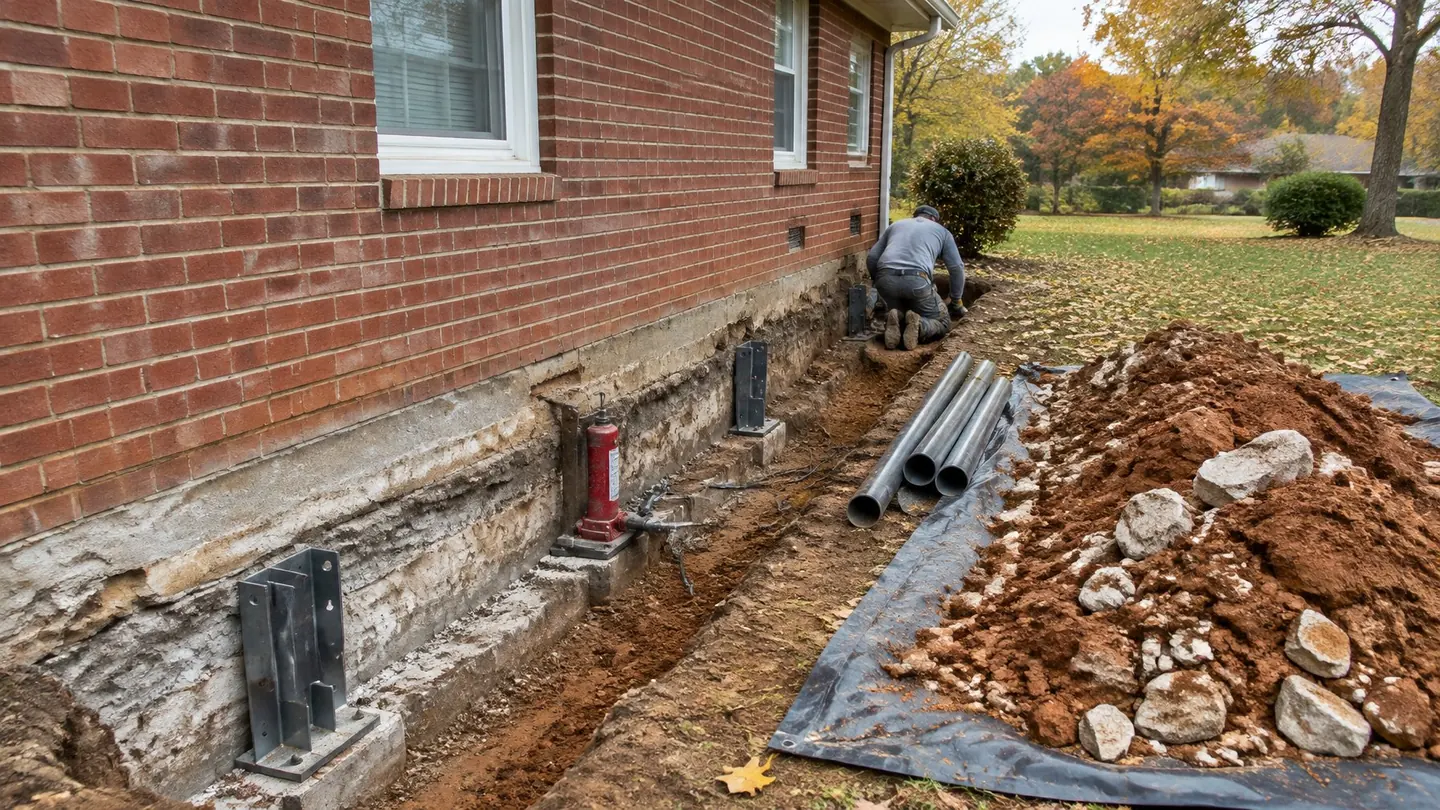
Under the footing
Piers: carrying the house on something deeper
Steel push piers
Steel tube in short sections is jacked downward, section upon section, through a bracket bolted to the footing. The jack braces against the house's own mass, and it quits once the tube lands on rock or on soil too stiff to yield. Suited to sunken outer walls of heavy buildings, brick houses among them.
Helical piers
Picture a giant wood screw: a steel shaft ringed with spiral plates, wound downward by a hydraulic drive head until a target torque shows on the gauge. No heavy wall is needed above it, which makes it the choice for porches, chimneys, additions, frame walls and crawl space supports.
Drilled concrete piers
An auger bores a shaft next to the footing or beneath it, a steel cage goes in, and concrete is poured. Popular in regions of deep, easily drilled soil. Seen less often over shallow rock.
Local question
Piers on shallow limestone
Around Murfreesboro a pier may meet rock only a few feet down, and a short pier is not automatically a bad one. What matters is what it stopped on. Limestone here is broken by vertical cracks and can have loose slabs and boulders sitting above the solid beds.
So ask how the installer knows each pier is bearing on sound rock, what load each one was tested to, and whether you will be given a log showing the depth and final pressure for every pier. Ask too how the bill changes should piers stop shallower, or run deeper, than the proposal assumed.
Slabs, walls and floors
Other methods you may see on a proposal
Slab lifting
Expanding foam, or else a cement slurry, is injected through coin-sized ports to pack the hollows beneath a slab and float it upward. Garage floors, driveways, walks and indoor slabs are the usual candidates, where the top layer of soil has settled. Deeper trouble is beyond its reach.
Braces and tie-backs for walls
Steel beams, carbon fibre straps, or rods tied to anchors in the yard, used on basement and crawl space walls that are bowing inward. The bowing walls page compares them.
Crawl space posts and beams
Adjustable steel posts on concrete pads, extra piers, and new or doubled beams and joists under a sagging floor. See crawl space repair.
Crack injection
Resin, either rigid epoxy or flexible polyurethane, forced into a poured-wall crack. It closes a dormant crack neatly and does nothing to quiet an active one.
Limits
What no method does
Stabilising and lifting are different goals. Many repairs are designed to stop further movement, with whatever lift comes easily as a bonus. Full recovery of a floor or a brick line is not always possible without damaging the house above.
Structural work does not mend the finishes. Repointing brick, patching drywall, relaying tile and replanting the beds that were dug up are usually separate, and so is testing the drain lines under a slab after it has been raised.
Nothing below ground removes the need to manage water at the surface. Gutters, downspouts and grading are part of every sound repair.
Put these to the company
Questions for any written proposal
- How many piers or supports, where exactly, and why that type for this house?
- Is the goal to arrest movement or to jack the building back up, and how far?
- Who designed the repair, and is an engineer's drawing or letter part of it?
- Who applies for the building permit?
- What will be dug up, cut or removed, and who puts it back?
- Which parts fall under the warranty, for what term, and who answers for it after a change of ownership?
Choosing a company goes further into licences and warranties.
One phone call
Speak with a foundation repair company near Murfreesboro
Mention the crack, the dip or the lean, name the room, and give the month you first spotted it. Whoever picks up belongs to a Middle Tennessee foundation outfit whose only tie to this website is the referral. They can pencil in an inspection and follow it with a written price.
A house that is cracking as you listen, a wall on the point of failing, gas in the air: everybody outside first, then 911 and the gas company.
Expect the call to be recorded. Two short pages cover the rest: who pays for referrals and what becomes of call details.